Managing Psychosocial Hazards
Last reviewed: June 2026
This page outlines the University’s approach to managing psychosocial hazards using the Health and Safety risk management process. It is intended to support managers, supervisors, local areas, Health and Safety teams, and Human Resources specialists to identify psychosocial hazards, assess and control risks, and review the effectiveness of controls.
The risk management principles available to manage physical hazards should be applied to manage psychosocial hazards.
Consultation with affected employees and relevant Health and Safety Representatives (HSRs) should occur throughout the risk management process, including when identifying hazards, selecting controls, and reviewing control effectiveness.
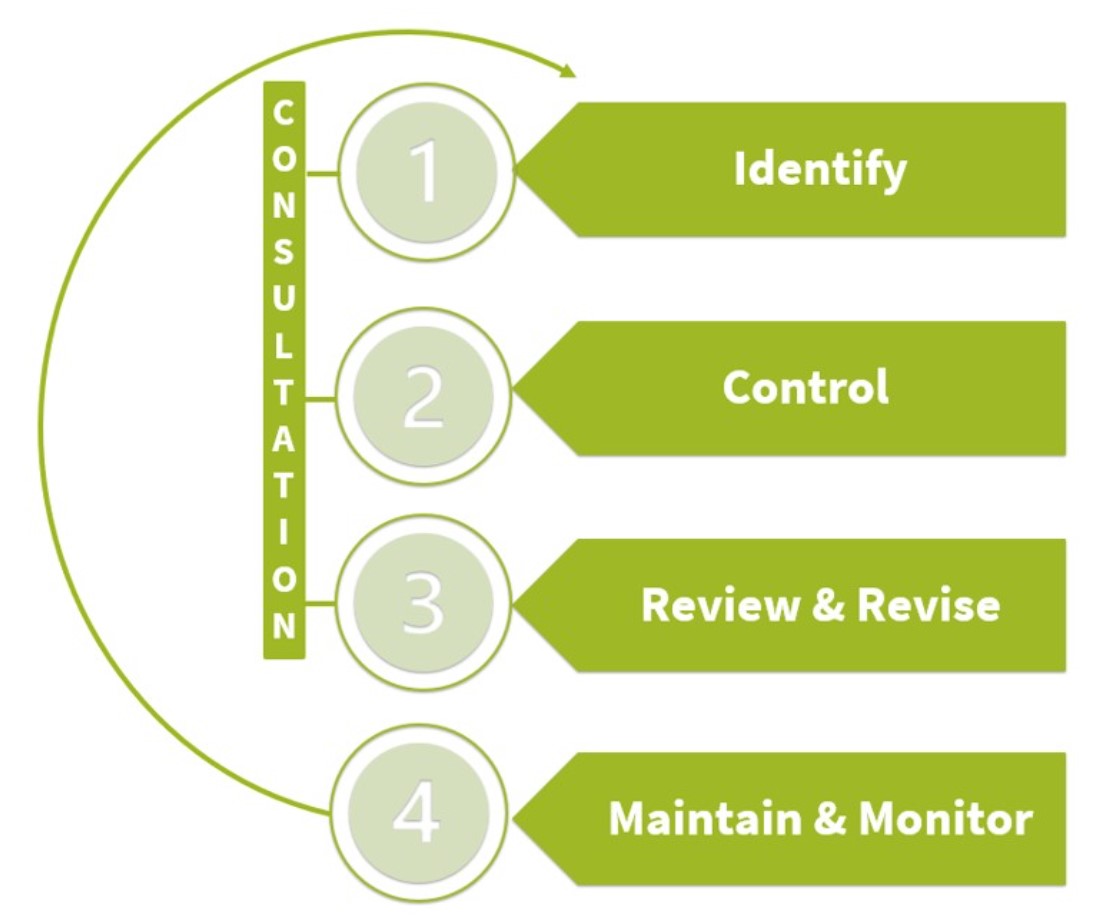
Identify
The purpose of this step is to:
- Identify psychosocial hazards
- Describe the hazard details, including:
- When and where the hazard is present;
- The frequency and duration of exposure;
- Potential combinations or interactions with other physical and/or psychosocial hazards;
- Additional risk factors that may increase the risk of harm.
- Document this information in the Health and Safety Psychosocial Risk Assessment Form.
Psychosocial hazards can be identified by reviewing internal information such as:
- Position descriptions
- Feedback from one-on-one supervision and team meetings
- Staff experience survey results
- Incident and hazard reports
- Health and Safety Representative feedback
- Local risk registers, action plans or previous risk assessments
Examples of how to identify psychosocial hazards and what questions to ask can be found in Appendix B of the WorkSafe Victoria Psychological Health Compliance Code.
Control
The purpose of this step is to:
- Document existing and proposed risk control measures in the Health and Safety Psychosocial Risk Assessment Form
- Select reasonably practicable control measures. Use the Health and Safety Psychosocial Hazard Library of Controls to assist in control selection.
- Implement agreed actions using the Health and Safety Action Plan
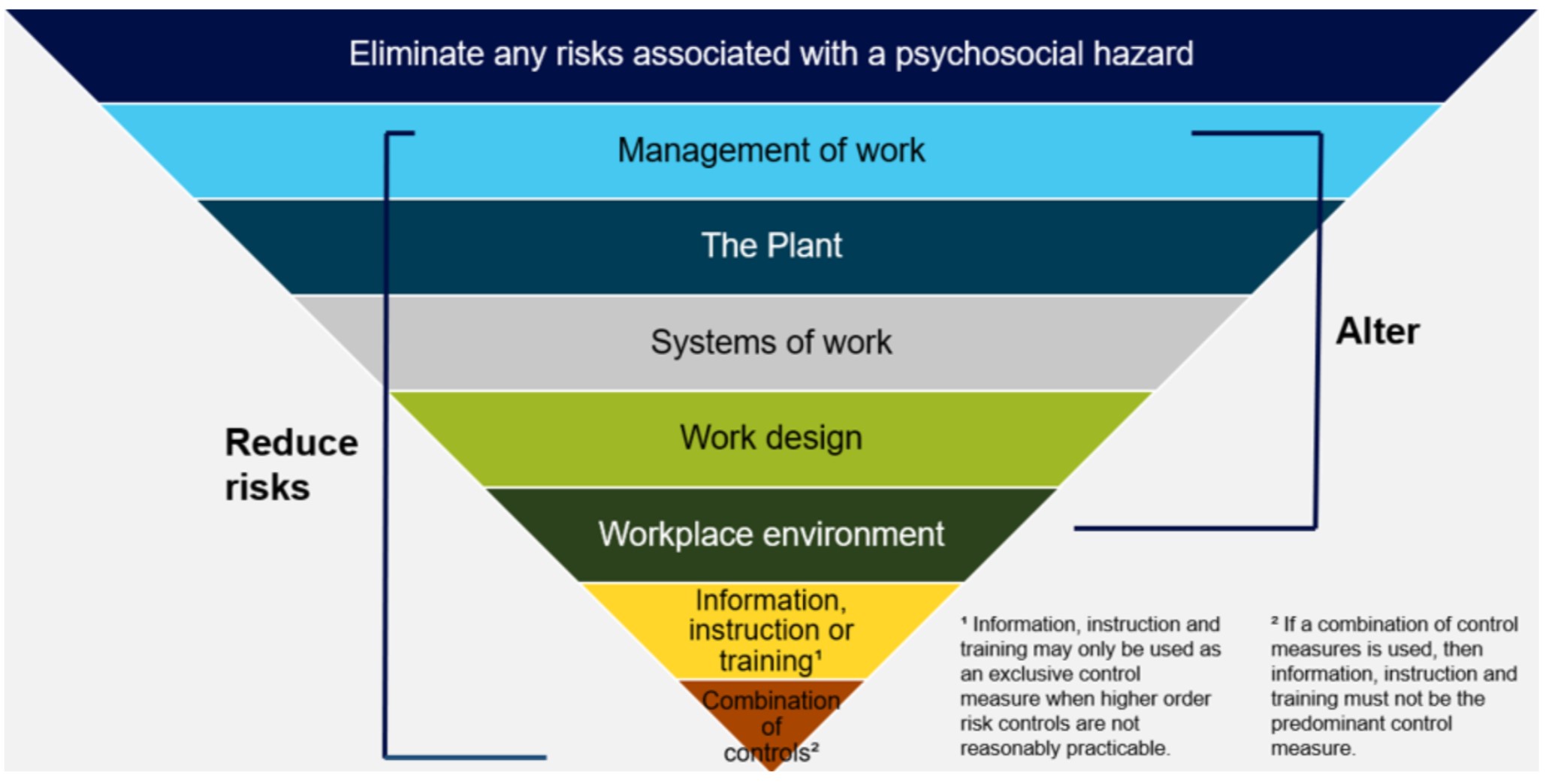
Psychosocial Hierarchy of Control
When selecting controls, first consider whether the risk can be eliminated. If elimination is not reasonably practicable, consider controls that reduce the risk by altering work design, systems of work, management of work, plant or the work environment.
Information, instruction and training may support other controls but should not be relied on as the only or main control unless other measures are not reasonably practicable.
The University of Melbourne has a range of controls to help manage psychosocial risks. You can review these existing measures by checking the relevant registers provided by the University:
- UoM OHS Risk Register
- Faculty or Department OHS Risk Register. Contact your local Health and Safety team for a copy.
Review and Revise
The purpose of this step is to:
- Evaluate whether existing controls are effectively managing the risk
- Review controls using the Psychosocial Hierarchy of Control
- Revise existing controls where required
- Update the Health and Safety Psychosocial Risk Assessment and the Health and Safety Action Plan
Risk controls must be reviewed when: | When we must revise: |
Before altering anything, process or system of work that is likely to change the risk associated with psychosocial hazards |
If the review finds that controls are not adequately controlling the risk so far as is reasonably practicable, the controls must be revised. |
If new or additional information about a psychosocial hazard becomes available | |
If a psychological injury or psychosocial hazard is reported | |
A notifiable incident involving a psychosocial hazard occurs | |
Risk control measures do not adequately control the risks | |
A Health & Safety Representative (HSR) requests a review |
Examples of how to review the effectiveness of existing controls and what questions to ask can be found in the WorkSafe Victoria Psychological Health Compliance Code.
Maintain and Monitor
The purpose of this step is to:
- Monitor local psychosocial hazards through informal and formal reports
- Maintain risk controls to ensure they continue to work as intended
- Consider continuous improvement opportunities.
Monitoring and maintenance activities may include:
- reviewing incident, hazard and injury reports
- discussing psychosocial hazards in team meetings or one-on-one conversations
- seeking feedback from employees and HSRs
- refreshing training, guidance or communication where required
- reviewing risk registers and action plans.
Psychosocial Risk Management Case Studies
To demonstrate how psychosocial risk management can be effectively applied in practice, a series of Risk Management Case Studies have been developed. These focus on key psychosocial hazards, including:
- Occupational Violence and Aggression
- Exposure to Traumatic Content
- High Job Demands
The case studies are available in the University of Melbourne’s Central Learning Hub: Central Learning Hub: Psychosocial Risk Management
Health and Safety Risk Assessment Methodology
To learn more about the University’s Health and Safety Risk Assessment Methodology, follow this link:
health-and-safety-risk-assessment-methodology.pdf (unimelb.edu.au)
To learn more about managing psychosocial hazards, follow these links: