Supervisor Guidance
Last reviewed: January 2026
TOP TIPS FOR SUPERVISORS
Supervisors have an important role in identifying psychosocial hazards, controlling associated risks, and maintaining and monitoring their effectiveness. This guide summarises existing University tools, processes and supports supervisors can utilise to control risk to psychological health of their teams.
-
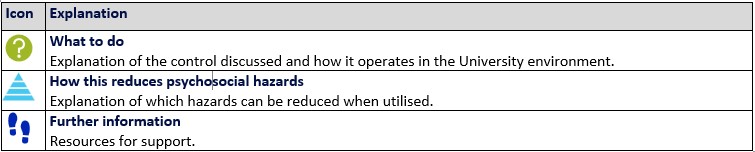
 What to do:
Position Descriptions (PDs) describe the scope, responsibilities, and required capabilities for fixed-term and continuing employees. Activity Descriptions (ADs) describe the tasks, objectives and/or outputs, hours of work and engagement period for casual employees. Supervisors should establish and maintain accurate and complete PDs and ADs help clarify work location, role requirements, job demands and expectations. Supervisors can use PDs and ADs to help identify and control psychosocial hazards that may emerge in job design and/or work environment.
 How this reduces psychosocial hazards:
Establishing and maintaining accurate and complete PDs and ADs reduces the likelihood of low role clarity and high/low job demands.
 Further information:
Position Descriptions and Role Classification guidance.
Enterprise Agreement - Division 3.
HR Business Partner for further guidance.
-
What to do:
Supervisors should proactively identify peak work periods and monitor changes in job demands. Workload planning determines how work is prioritised and distributed to ensure employees have the resources and support to perform their work safely and sustainably. Supervisors play a key role in leading the reprioritisation of timeframes or deliverables, redistributing tasks within the team, coordinating assistance from others, or using different tools or methods to reduce demand. Effective workload planning promotes sustainable performance and supports equitable workload distribution.
How this reduces psychosocial hazards:Regular workload planning, monitoring of job demands, and reprioritising of workload reduces the likelihood of high job demands and low job control.
Further information:Enterprise Agreement - Clauses 1.16, 2.11, 3.15, and 4.3.
Managing excess leave guidance.
HR Business Partner for further guidance.
-
What to do:
Supervisors should hold regular, structured 1:1s with each direct report to provide guidance, exchange feedback, review job demands, prioritise work, address concerns, and recognise achievements. Regular 1:1s maintain open communication, strengthen relationships, and support early identification of psychosocial risks.
How this reduces psychosocial hazards:Regular 1:1s reduce the likelihood of high/low job demands, low role clarity, poor support, and low reward/recognition.
Further information:Staff Hub Human Resources webpage.
Enterprise Agreement - clauses 1.35, 2.14, 2.17, and 3.29.
HR Business Partner for further guidance.
-
What to do:
Performance and Development Framework (PDF) for professional staff and the Performance Development Review (PDR) for academic staff to provide consistent, two-way constructive feedback and performance evaluation. Supervisors should utilise these frameworks to set aligned and measurable goals that build capability.
How this reduces psychosocial hazards:Supervisors who utilise the PDF or PDR reduce the likelihood of low role clarity, low job control, and low reward/recognition.
Further information:Staff Development, Education and Performance Policy (MPF1227).
Enterprise Agreement - clauses 1.35, 2.17, and 3.6.
HR Business Partner for further guidance.
-
What to do:
Supervisors should ensure that all direct reports are up to date with all required core compliance training. Core compliance training provides critical information on behavioural expectations and health and safety. Core compliance training includes the Appropriate Workplace Behaviour, Respect Education, Health & Safety Roles and Responsibilities training programs.
How this reduces psychosocial hazards:Ensuring that your direct reports have completed core compliance training reduces the likelihood of bullying, racism, sexual harassment, and gendered based violence, and provides information, instruction and training about the reporting of inappropriate workplace behaviours.
Further information:TrainME Reports/Administration Access webpage.
Compliance training webpage.
HR Business Partner for further guidance.
-
What to do:
Supervisors should promote and encourage utilisation of wellbeing supports within team and individual meetings. This creates visibility on available supports and encourages help-seeking behaviours.
How this reduces psychosocial hazards:Regular promotion of staff supports reduces the likelihood of poor support and can assist in harm reduction of other hazards such as exposure to traumatic events and content, and violence or aggression.
Further information:Psychosocial and Mental Health webpage
Staff Hub Human Resources webpage.
-
What to do:
Supervisors should actively build their people leadership capability. Available resources include the Manager Support Program (Assure) and the Central Learning Hub (UoM Organisational Development). These resources provide practical guidance and development opportunities to strengthen effective and supportive leadership.
How this reduces psychosocial hazards:People leadership skills reduce the likelihood of poor support and poor workplace relationships.
Further information:HR Business Partner for further guidance.
-
What to do:
Supervisors should review Staff Experience Survey outcomes with their teams, and when reasonably practicable, collaborate on action plans in response. The survey provides an anonymous platform for employees to share their workplace experiences, with deidentified results made available to local areas.
How this reduces psychosocial hazards:Responding to and planning actions in response to survey data helps identify psychosocial hazards and cohorts with increased exposure, facilitating action plans to address hazards and risks at local levels.
Further information:Staff Experience Survey webpage.
HR Business Partner for further guidance.
-
What to do:
When reasonably practicable, supervisors should engage and consult with employees before, during, and after work-related changes. Change can impact existing risks or introduce new ones, and consultation is especially important when changes affect work activities, processes, leadership, the work environment, equipment or resources, or workforce structure. Ongoing engagement helps employees adjust and ensures they receive appropriate support.
How this reduces psychosocial hazards:Consulting and engaging with employees during change reduces the likelihood of poor change management, poor support, and low role clarity.
Further information:Enterprise Agreement - clauses 1.40, 1.41, and 1.70.
Health & Safety: Risk Management Requirements.
HR Business Partner or Health & Safety Business Partner for further guidance.
-
What to do:
Supervisors should model respectful behaviour, consult on psychosocial risks, and reinforce clear behavioural and wellbeing expectations. Effective psychosocial risk management occurs when supervisors take ownership of psychosocial risk in their workplace.
How this reduces psychosocial hazards:Leading by example reduces the likelihood of poor support, poor workplace relationships, and poor organisational justice.
Further information:Enterprise Agreement - clause 1.8.
Appropriate Workplace Behaviour Policy.
HR Business Partner for further guidance.
-
What to do:
Supervisors should encourage reporting behaviours of concern and ensure direct reports are aware of how behaviours of concern can be reported to UoM Security, Human Resources, Workplace Investigations, the Safer Community Program, or via the Speak Safely Portal.
How this reduces psychosocial hazards:Encouraging the reporting of behaviours of concern reduces the likelihood poor support, poor workplace relationships, and poor organisational justice.
Further information:Safer Community Program webpage for information on student and staff conduct complaints.
Educators Guide webpage.
HR Business Partner for further guidance.
-
What to do:
Supervisors should regularly review the physical work environment to ensure it supports health and safety. This includes maintaining equipment, monitoring lighting and noise, implementing security measures such as duress alarms and access controls, considering suitability of working environment for tasks, and verifying that employees have adequate resources.
How this reduces psychosocial hazards:Supervisors who regularly review the physical environment identify and manage existing and additional risks promptly, reducing violence and aggression, poor environmental conditions, and poor support.
Further information:Workplace monitoring, inspections and checklists webpage.
University Security webpage.
Health & Safety Business Partner for further guidance.
KEY TERMS
Psychosocial Hazard refers to anything in the working environment that could cause an employee to have a negative psychological response. This response can lead to psychological or physical harm, or both.
Psychological Health, sometimes called mental health, includes our emotional, psychological, and social well-being. It affects how we think, feel, and act. It also helps determine how we handle stress, relate to others and make healthy choices.
Psychological health and safety refers to protecting the psychological health of employees, in the same way that we protect physical health.
Psychological Safety is the belief that one will not be punished or humiliated for speaking up with ideas, questions, concerns or mistakes, and the team is safe for interpersonal risk-taking.
LEGEND
REFERENCES
Occupational Health and Safety Act 2004 (Vic)
Occupational Health and Safety (Psychological Health) Regulations 2025 (Vic)
ISO 45003:2021 – Psychological health and safety at work guidelines 2021